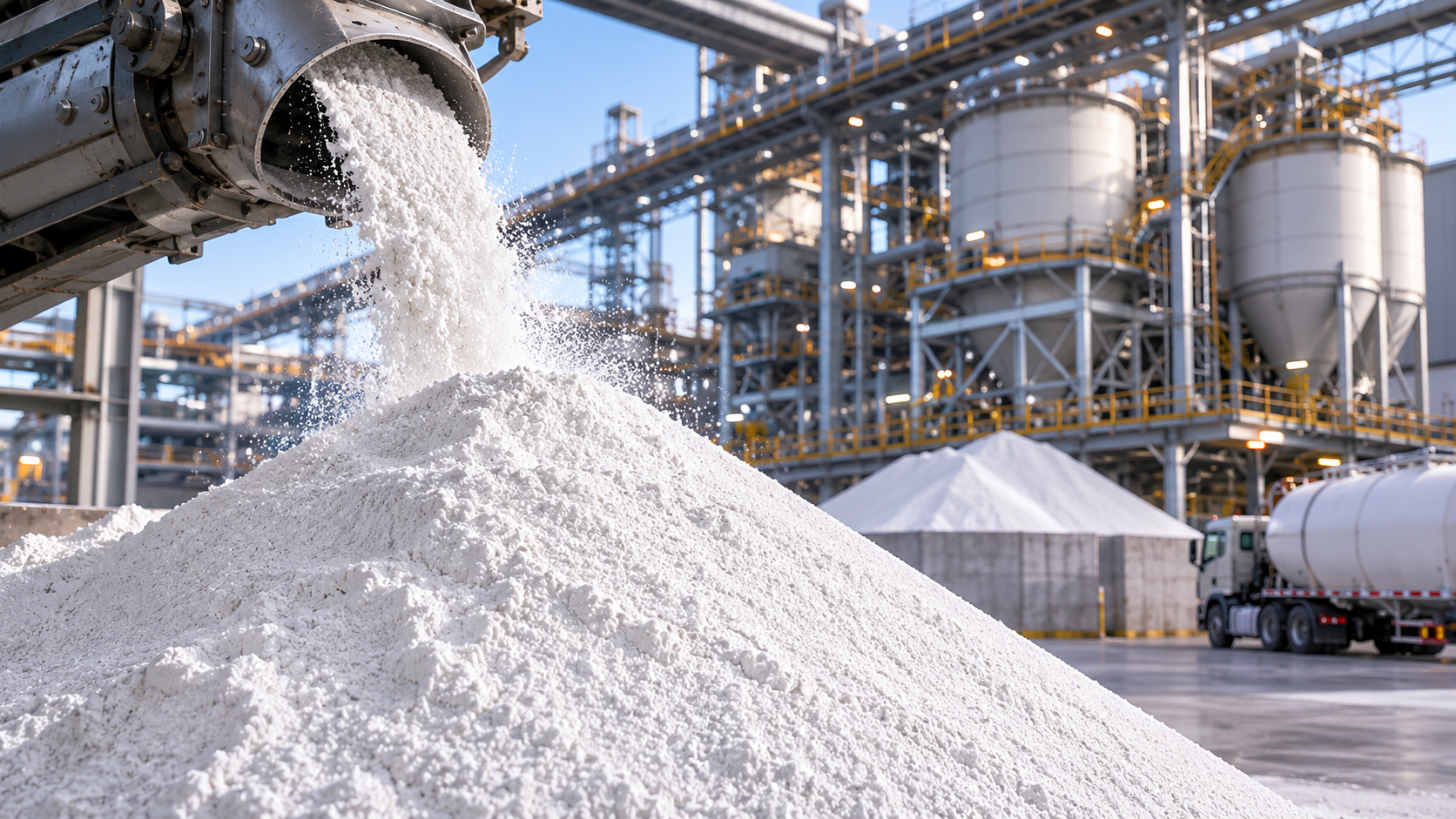

Bauxite to Alumina: How the Bayer Process Actually Works
Aluminium is everywhere—from buildings and automobiles to electrical systems, packaging and industrial equipment.
But aluminium does not come directly out of the ground.
Its journey usually begins with bauxite, an aluminium-rich ore. Bauxite is mined, prepared and chemically refined to produce alumina (aluminium oxide, Al₂O₃). Only after that is alumina sent to an aluminium smelter, where it can be converted into metallic aluminium.
The industrial process responsible for producing most of the world’s alumina is known as the Bayer process.
At first glance, the concept appears simple: dissolve the aluminium-bearing minerals from bauxite, separate the unwanted material and recover alumina.
At industrial scale, however, it is a carefully controlled combination of mineral preparation, chemistry, temperature, pressure, separation and recycling.
Here is what actually happens between bauxite and alumina.
First, What Exactly Is Bauxite?
Bauxite is not a single mineral.
It is an ore containing aluminium-bearing minerals together with varying amounts of iron oxides, silica, titanium-bearing minerals and other constituents.
That distinction is important.
Two bauxite deposits can have similar alumina percentages but behave differently during refining because their mineralogy and impurities are different.
This is why a bauxite deposit cannot be understood only through one number.
Parameters such as available alumina, reactive silica, iron content, moisture and mineralogy can influence how suitable the ore is for alumina refining and how it behaves inside the Bayer process.
Before the refinery begins processing bauxite, understanding the characteristics of the ore is therefore fundamental.
From Mine to Refinery
Bauxite is generally produced through open-cast mining because many commercial deposits occur relatively close to the surface.
Mining begins with removal of overburden where required, followed by excavation of the bauxite-bearing material.
But refinery performance starts at the mine.
Selective mining and grade control can help maintain a more consistent feed. Different areas of a deposit may contain different grades or impurity levels, so appropriate mine planning, sampling and blending can become important before the ore reaches the refinery.
After mining, the bauxite is transported for processing.
The Bayer process can then be understood through a series of major stages:
Bauxite Preparation → Digestion → Clarification → Precipitation → Calcination → Alumina
Each stage has a specific purpose.
Step 1: Preparing the Bauxite
The first objective is to prepare the bauxite for efficient chemical processing.
The ore is crushed and, depending on the refinery and characteristics of the material, may undergo additional preparation before digestion.
Reducing particle size increases the surface area available for reaction and helps the caustic solution interact effectively with the aluminium-bearing minerals.
The prepared bauxite is then mixed with a concentrated solution containing sodium hydroxide, commonly known as caustic soda.
This creates the slurry that enters one of the most important stages of the Bayer process: digestion.
Step 2: Digestion — Dissolving the Aluminium
During digestion, the bauxite slurry is subjected to elevated temperature and, where required, pressure.
The purpose is selective extraction.
Under strongly alkaline conditions, aluminium-bearing minerals in the bauxite react with the caustic solution. The aluminium enters the liquid phase primarily as dissolved sodium aluminate.
Many of the unwanted minerals do not dissolve in the same way.
This difference in chemical behaviour is the basis of the Bayer process.
Instead of trying to physically separate every aluminium mineral from every impurity beforehand, the refinery uses chemistry to selectively bring aluminium into solution.
The exact digestion conditions depend significantly on the mineralogy of the bauxite.
Different aluminium-bearing minerals respond differently to temperature and processing conditions. This is one reason why understanding the ore body is so important to refinery design and operation.
After digestion, the refinery has a mixture containing an aluminium-rich solution and undissolved solid residues.
Those solids now have to be removed.
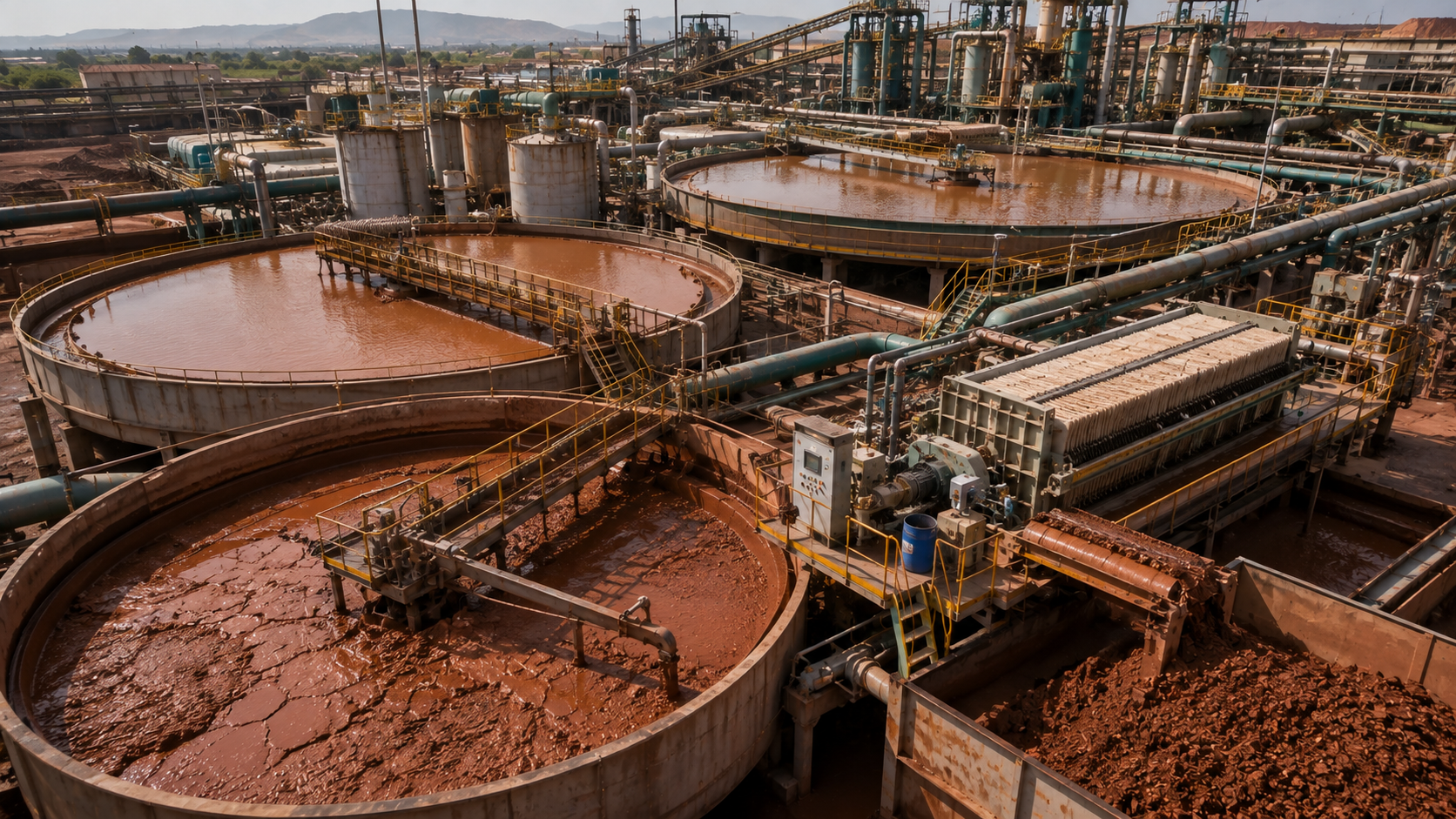
Step 3: Clarification — Separating the Residue
The slurry leaving digestion contains unwanted insoluble material, including a significant proportion of the iron-rich components originally present in the bauxite.
This residue is commonly referred to as bauxite residue, or more informally as red mud because of its characteristic colour.
During clarification, the solid residue is separated from the sodium-aluminate-rich liquor.
Settling systems, thickeners and filtration can be used as part of this separation and washing process.
Washing the residue is important because the objective is not only to remove unwanted solids. The refinery also wants to recover as much valuable caustic and dissolved aluminium as reasonably possible before the residue leaves the process circuit.
Bauxite residue management is consequently one of the major environmental and operational considerations associated with alumina refining.
Once the solids have been removed, the refinery is left with a clarified solution containing dissolved aluminium.
The next challenge is to get that aluminium back out of solution—but this time in a controlled and useful form.
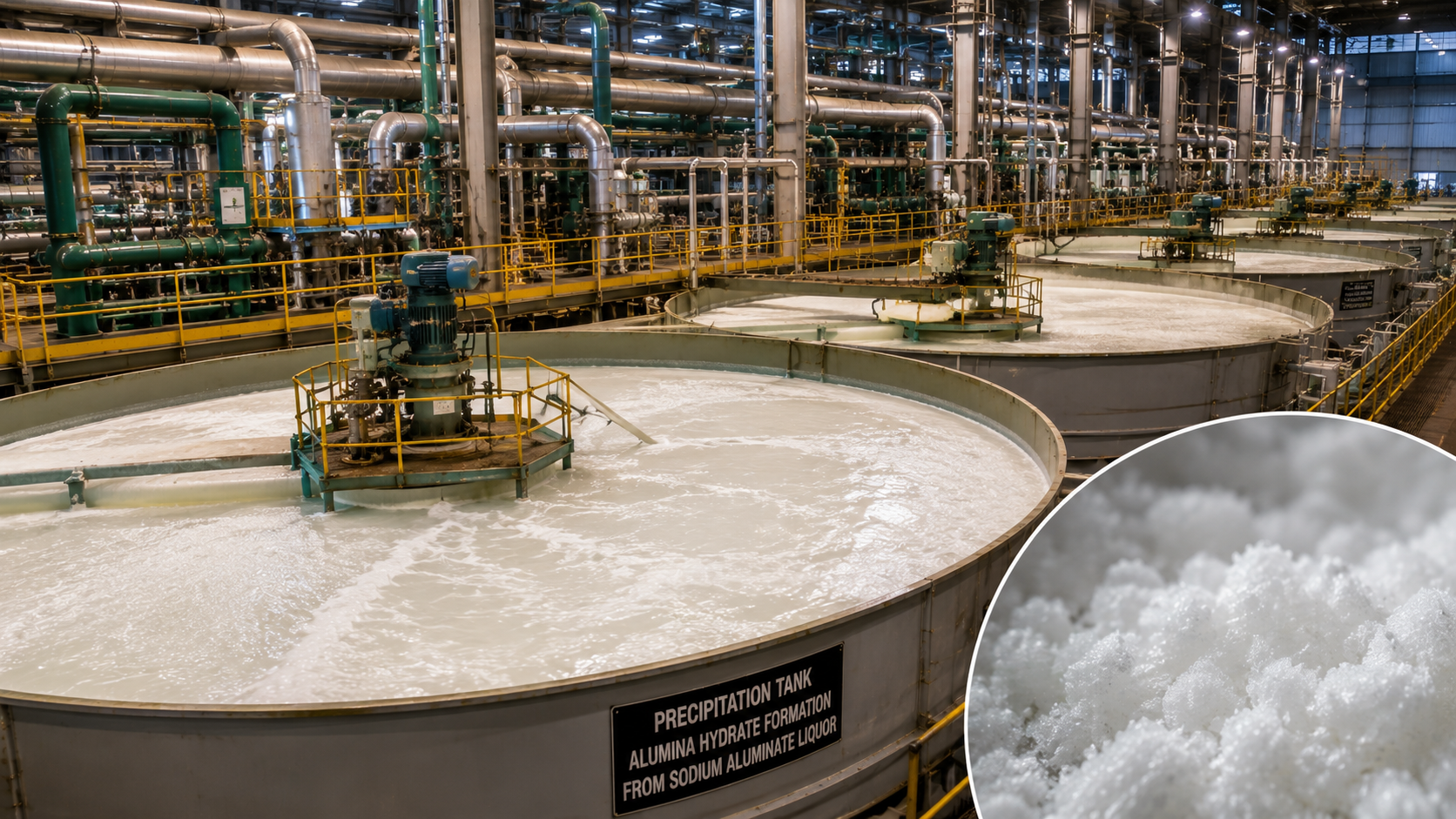
Step 4: Precipitation — Bringing Aluminium Back Out
The clarified sodium aluminate liquor is cooled and directed to precipitation.
Fine crystals of aluminium hydroxide are introduced as seed material.
These seed crystals provide surfaces on which additional aluminium hydroxide can precipitate from the solution.
As precipitation progresses, aluminium that had been dissolved during digestion is recovered as solid aluminium hydroxide.
Controlling this stage is extremely important.
Temperature, residence time, liquor concentration and seed characteristics can influence the size and properties of the precipitated material.
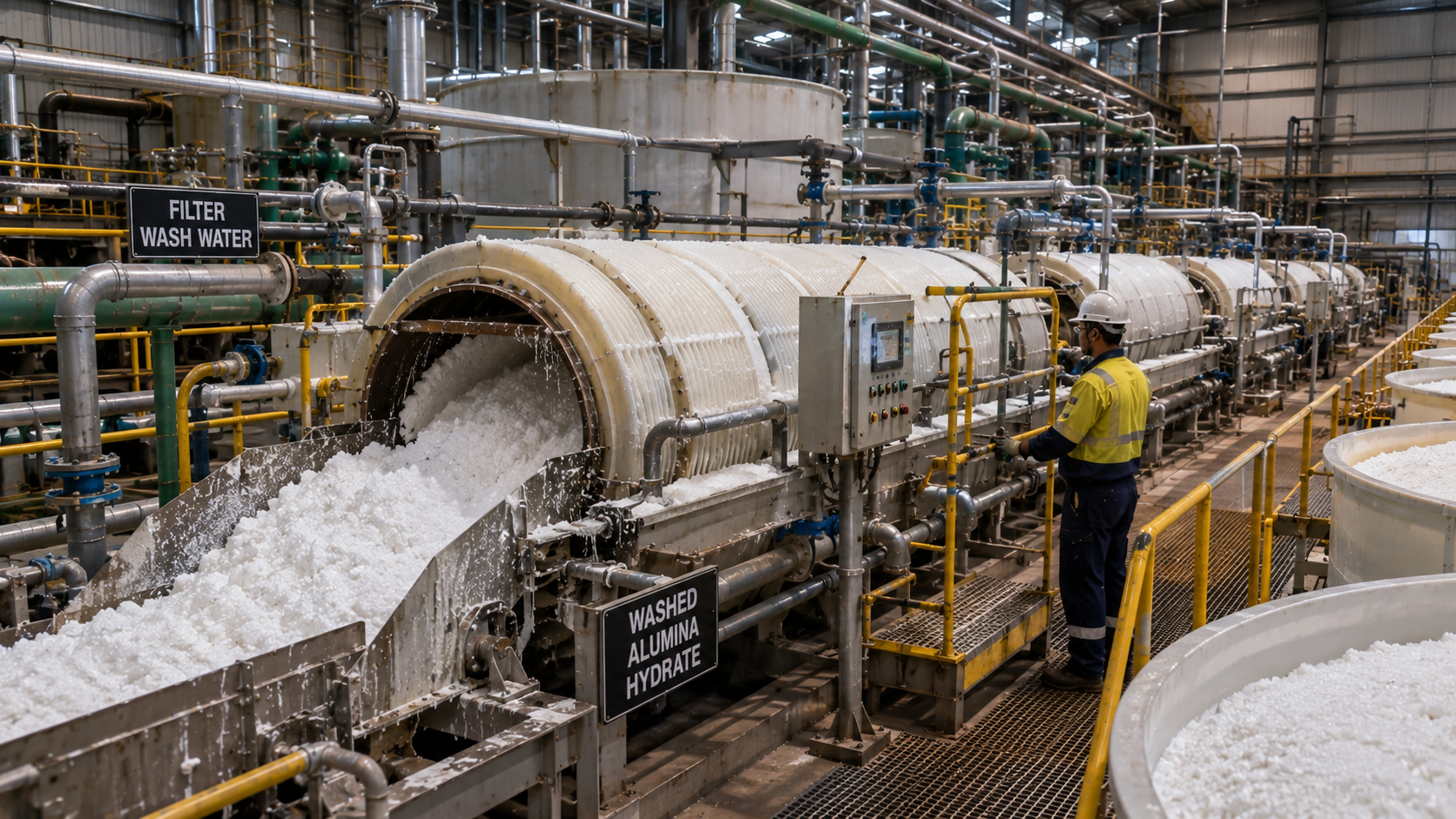
The aluminium hydroxide is then separated from the remaining liquor.
But the liquor is not simply discarded.
One of the defining features of the Bayer process is its internal recycling.
The caustic-bearing liquor can be returned to the process and reused for the digestion of additional bauxite, reducing the need to continuously replace the entire chemical solution.
The aluminium hydroxide, meanwhile, moves to the final major conversion stage.
Step 5: Calcination — Producing Alumina
At this point, the product is aluminium hydroxide rather than the alumina required by an aluminium smelter.
The final transformation takes place through calcination.
Aluminium hydroxide is heated to high temperatures in industrial calciners.
During heating, chemically bound water is driven off, converting aluminium hydroxide into aluminium oxide:
2Al(OH)₃ → Al₂O₃ + 3H₂O
The resulting material is alumina—typically a white, powder-like aluminium oxide product.
This is the material that forms the principal feedstock for primary aluminium production.
And this is where the Bayer process ends.
Alumina Is Not Aluminium
This distinction is worth emphasising.
Bauxite → Alumina → Aluminium
These are three different materials and involve two major industrial processes.
The Bayer process converts bauxite into alumina.
The subsequent Hall-Héroult process converts alumina into metallic aluminium through electrolytic reduction.
So an alumina refinery and an aluminium smelter perform fundamentally different jobs.
A refinery uses chemical processing to extract and purify aluminium oxide from bauxite.
A smelter uses large quantities of electrical energy to extract aluminium metal from that oxide.
Understanding this separation makes the entire aluminium value chain much easier to follow.
Why Bauxite Quality Matters
The Bayer process may take place inside the refinery, but its economics begin with the characteristics of the bauxite entering it.
Higher alumina content can mean more potential product per tonne of ore, but total alumina alone does not tell the full story.
The form in which that alumina occurs matters.
So do impurities.
Silica is particularly important because reactive silica can consume caustic soda and aluminium during processing, potentially affecting refinery efficiency and increasing operating costs.
Iron, titanium minerals and other constituents also influence residue generation and overall processing behaviour.
This is why bauxite evaluation requires more than asking:
“What is the Al₂O₃ percentage?”
A better question is:
“How will this particular bauxite behave inside the refinery?”
For miners and processors, that changes the way an ore body is approached. Geological understanding, sampling, grade control, beneficiation where appropriate, blending and consistent supply all become part of the broader alumina value chain.
From Resource to Industrial Raw Material
The Bayer process demonstrates an important principle in mineral processing: finding a mineral resource is only the beginning.
Value is created by understanding the material and controlling what happens to it through each subsequent stage.
For a bauxite producer, this means looking beyond tonnes mined. Consistent chemistry, impurity control, mine planning and knowledge of downstream refinery requirements can all influence the usefulness of the ore to the customer.
Within Maa Kudargarhi Group, our involvement in bauxite mining and mineral processing gives us this upstream perspective. We see bauxite not simply as an ore to be extracted, but as the starting material for a much larger industrial chain.
Because long before aluminium becomes a car component, electrical conductor or beverage can, the process starts with understanding the bauxite beneath the ground—and how to turn the aluminium contained within it into alumina.