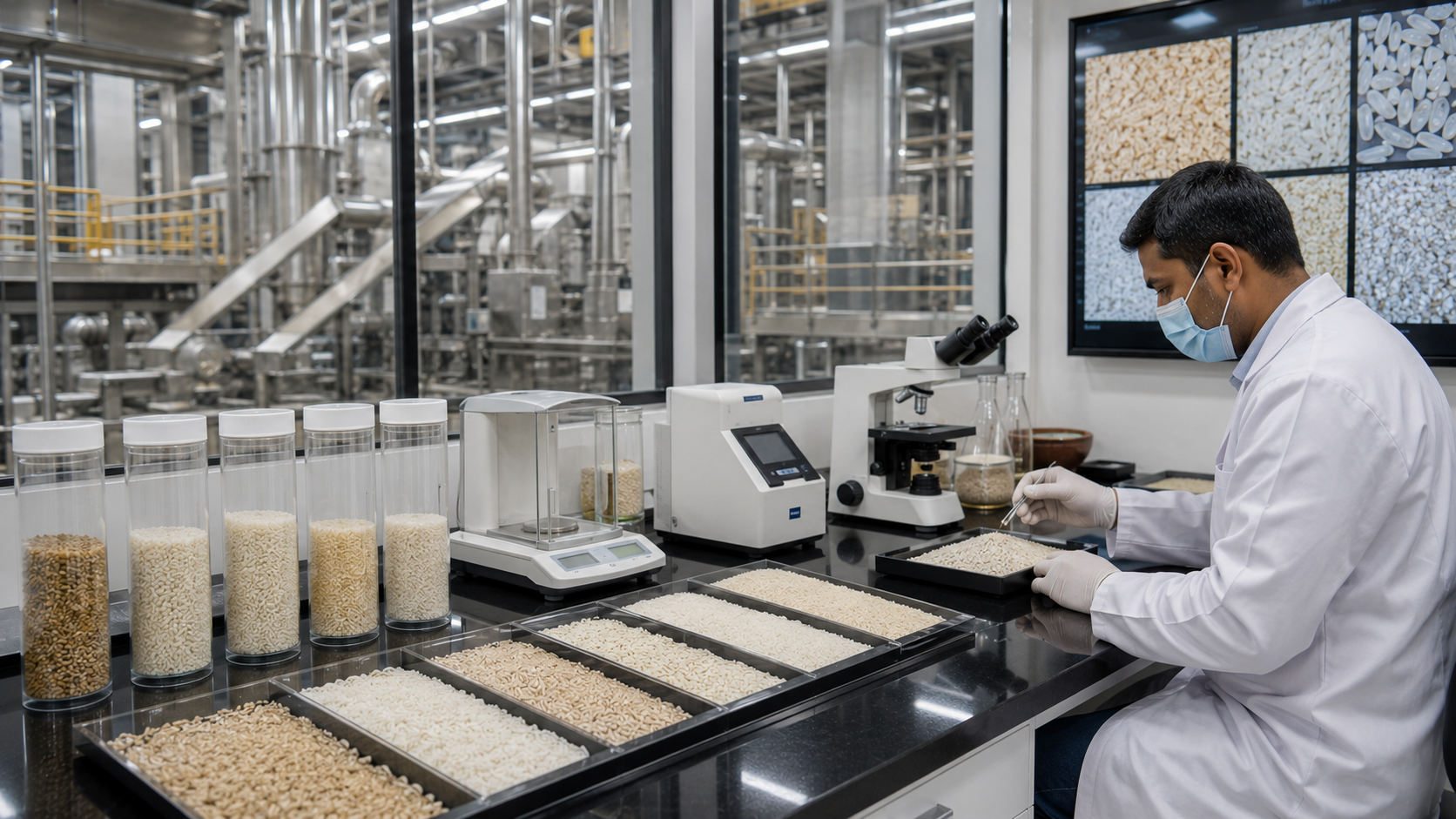

What Actually Happens Between Paddy and Packed Rice?
A bag of rice on a supermarket shelf looks like a simple product.
Clean grains, uniform colour, consistent size, packed and ready for cooking.
But rice does not leave the farm looking anything like this.
What farmers harvest is paddy—rice grains still protected by an outer husk and carrying varying levels of moisture, dust and other material from harvesting and handling.
Turning that paddy into the rice we eat requires a carefully controlled sequence of cleaning, drying, milling, separation, grading and quality checks.
The basic idea is simple: remove everything that should not be there while keeping as much of the grain intact as possible.
Doing that efficiently at an industrial scale is where rice milling becomes considerably more technical.
It Starts With the Paddy
Good rice processing begins before the milling machines start.
When paddy arrives at a rice mill, its condition can vary depending on the variety, growing conditions, harvesting method, moisture level and storage.
The first task is therefore to understand the incoming raw material.
Paddy may contain straw, dust, stones, immature grains and other foreign material. Moisture is particularly important because paddy that is too wet can create storage problems, while improper drying can increase grain breakage during subsequent processing.
The miller’s job is not simply to remove the husk.
It is to manage the grain through each stage so that the maximum possible quantity of good-quality rice reaches the final pack.
Step 1: Cleaning the Paddy
Before milling begins, the paddy has to be cleaned.
Industrial cleaning systems remove unwanted material such as dust, straw, stones and other impurities that may have entered during harvesting, transportation or storage.
Different contaminants behave differently, so cleaning generally involves more than one mechanism.
Screens can separate material based on size. Aspiration systems can remove lighter impurities. Destoners help separate stones and other dense foreign material from the grain.
This stage protects both the final product and the milling equipment downstream.
Sending unclean paddy directly into a milling line would increase wear on machinery and make maintaining consistent finished-rice quality much more difficult.
Step 2: Moisture and Drying
Moisture has a major influence on how paddy behaves during milling.
Freshly harvested paddy can contain more moisture than is suitable for safe storage or efficient milling. It therefore needs to be brought to an appropriate moisture level under controlled conditions.
Drying sounds simple, but it has to be handled carefully.
Removing moisture too aggressively or unevenly can create stress within the grain. That matters later because stressed grains are more likely to crack and break during milling.
For a rice mill, broken rice is not merely a visual issue.
Whole grains and broken grains are generally separated into different commercial grades. Increasing the proportion of whole kernels recovered from a given quantity of paddy therefore directly affects the value obtained from the raw material.
Drying is consequently both a quality-control step and an economic one.
Step 3: Removing the Husk
Once the paddy is ready for milling, the outer protective husk has to be removed.
This process is called dehusking or husking.
The objective is to separate the husk without unnecessarily damaging the grain inside.
After husking, the material is no longer simply paddy. It contains brown rice, separated husk and potentially some grains that have not been completely dehusked.
The husk is removed from the product stream, while a paddy separator can separate unhusked grains from brown rice so that the unhusked material can be returned for another pass.
This circulation is an important part of efficient milling. Instead of forcing every grain through excessive mechanical treatment, the system separates what still needs processing from what is ready for the next stage.
The brown rice that emerges still contains its bran layers.
To produce conventional white rice, these layers have to be removed.
Step 4: From Brown Rice to White Rice
The next major operation is whitening.
During this stage, milling equipment removes the bran layers surrounding the rice kernel.
The amount of milling has to be controlled.
Too little processing can leave the rice below the desired appearance or specification. Excessive milling, on the other hand, removes more material than necessary and can reduce the overall yield.
This illustrates one of the recurring principles of rice manufacturing:
More processing does not automatically mean a better product.
The goal is controlled processing.
Depending on the required finished product, rice may subsequently undergo polishing to improve its surface finish and appearance.
By this point, the grain increasingly resembles the white rice consumers recognise.
But it is still not necessarily ready to be packed.
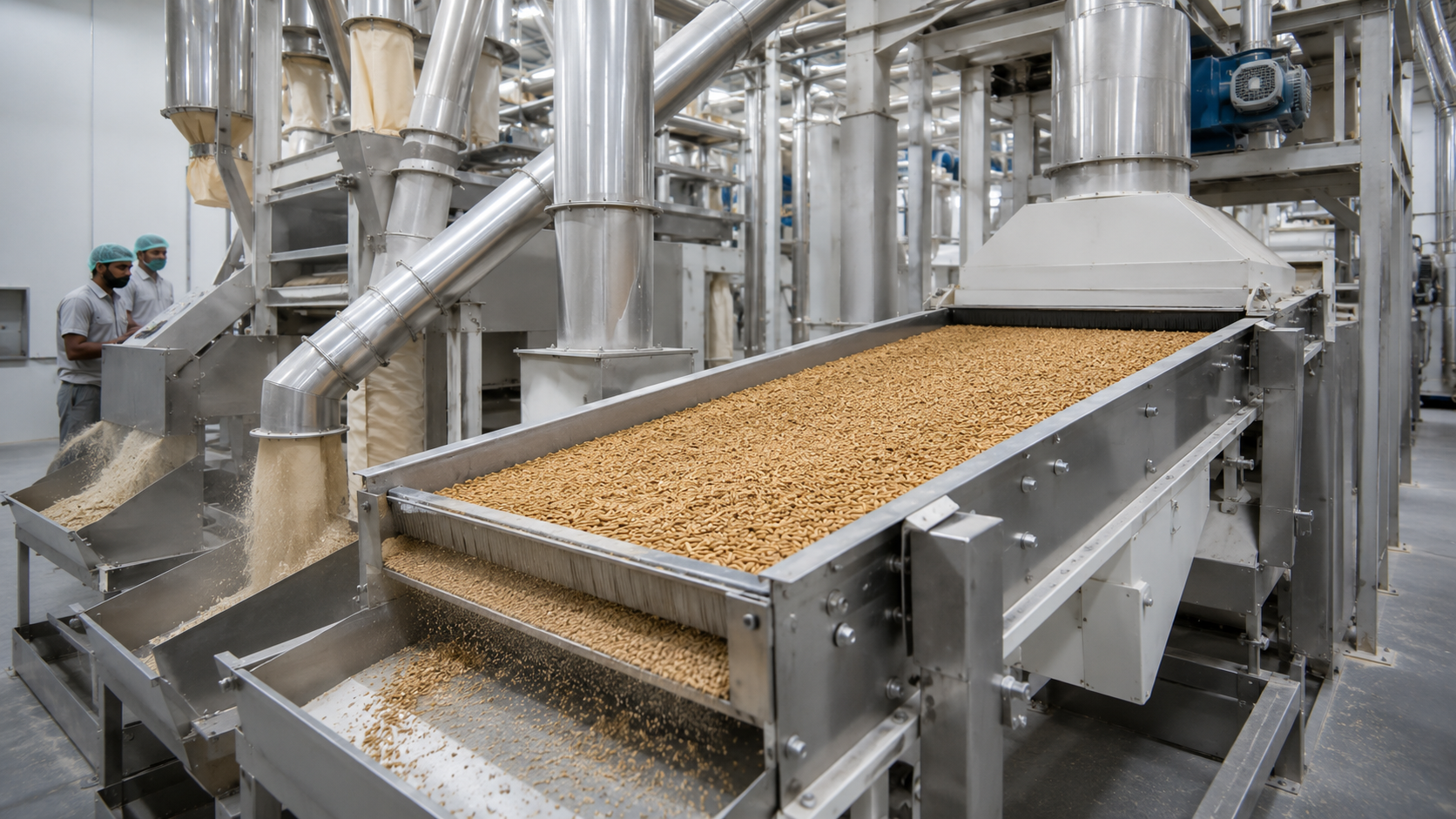
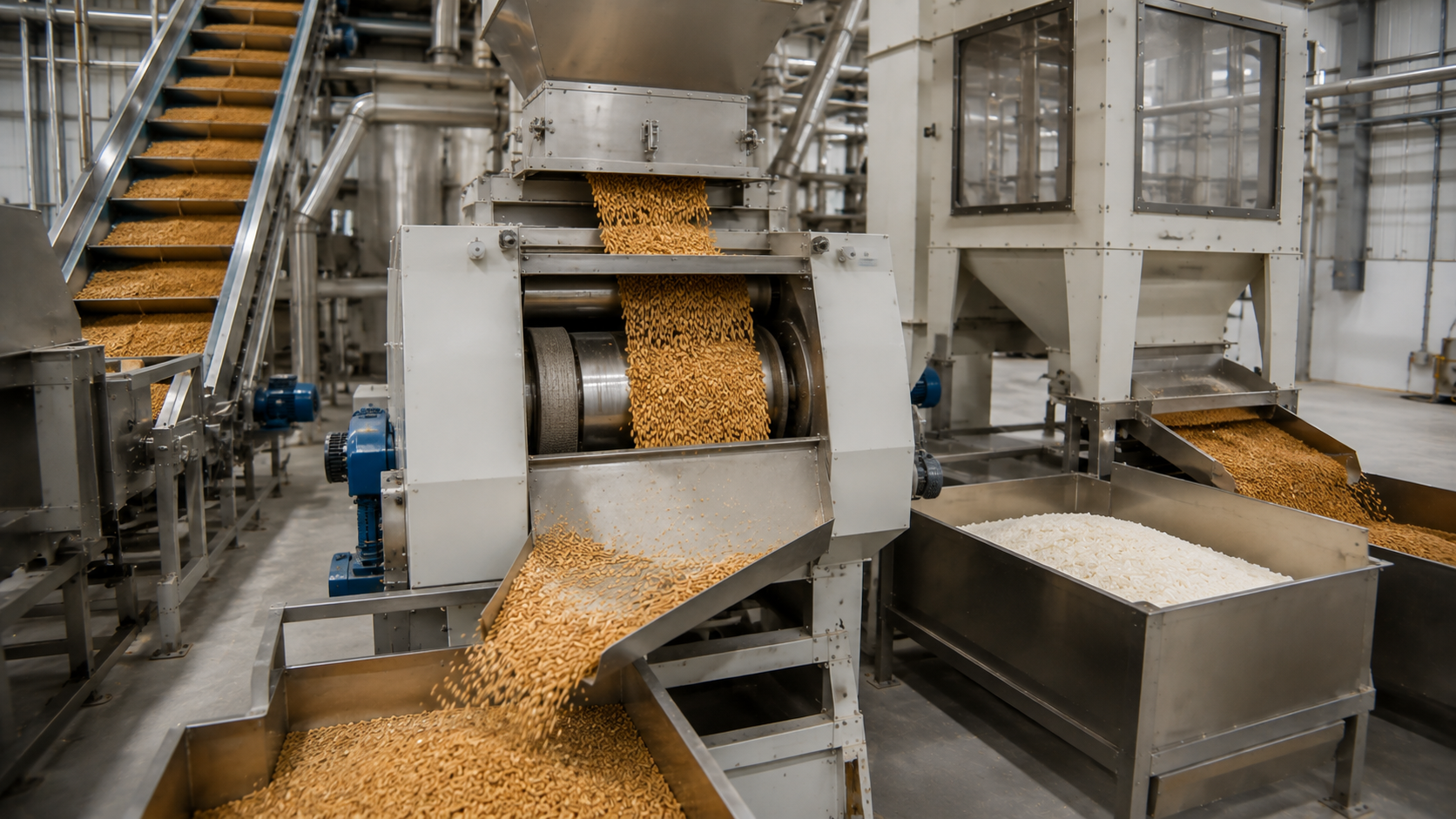
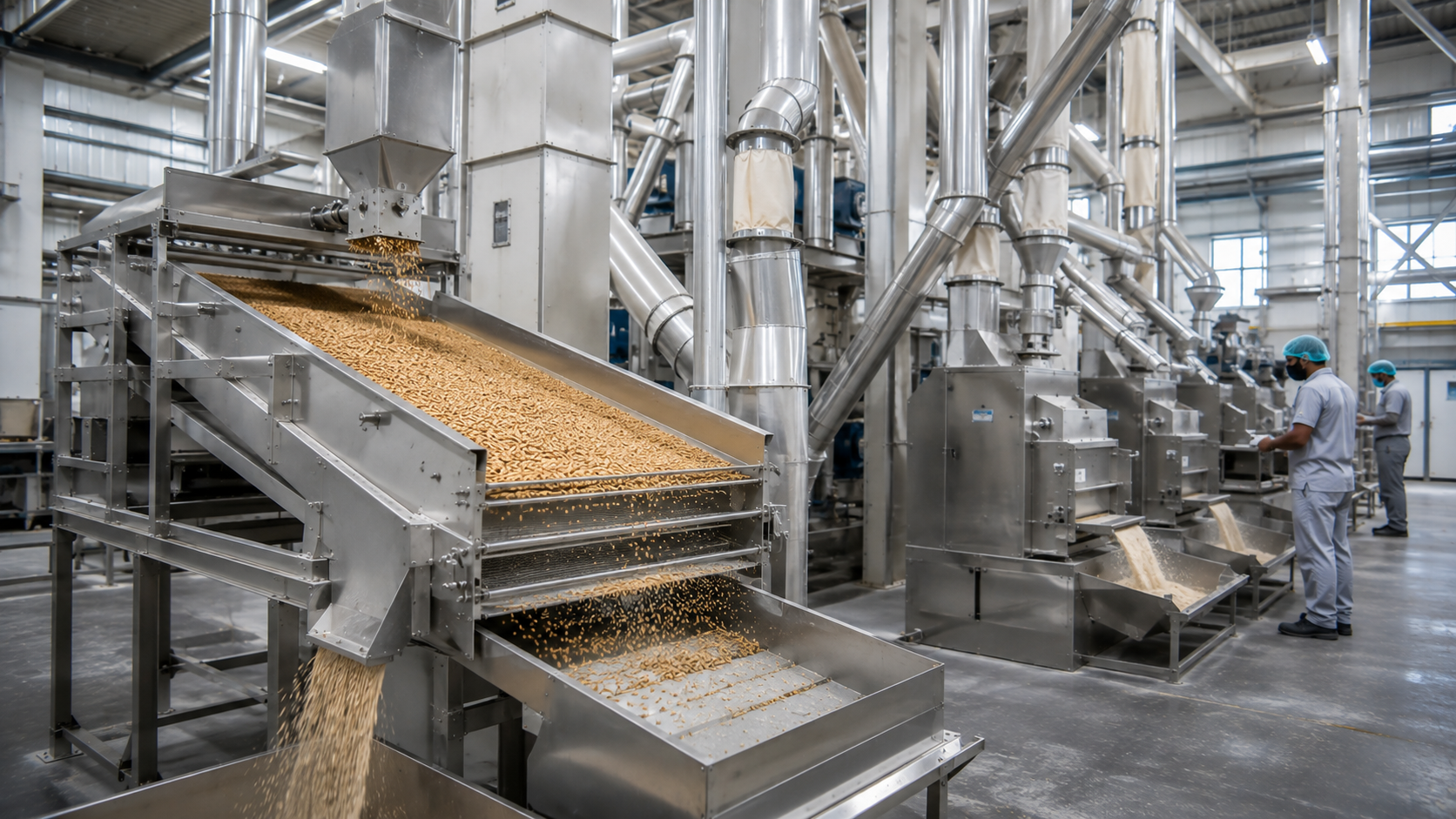
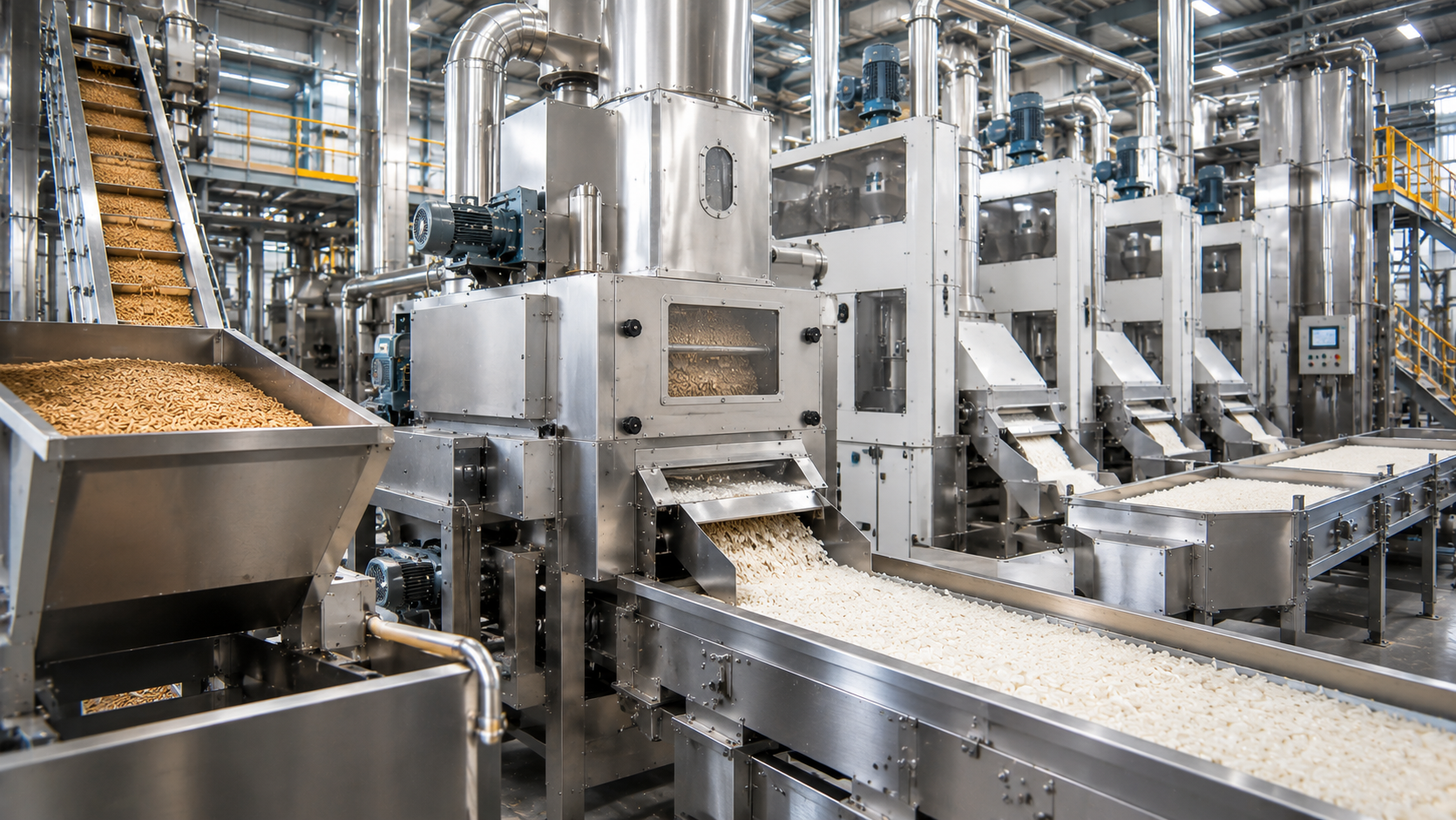
Step 5: Separating Whole and Broken Rice
Rice kernels do not all survive the milling process intact.
Some break because of stresses developed during harvesting, drying, storage or milling. The resulting mixture therefore needs to be graded.
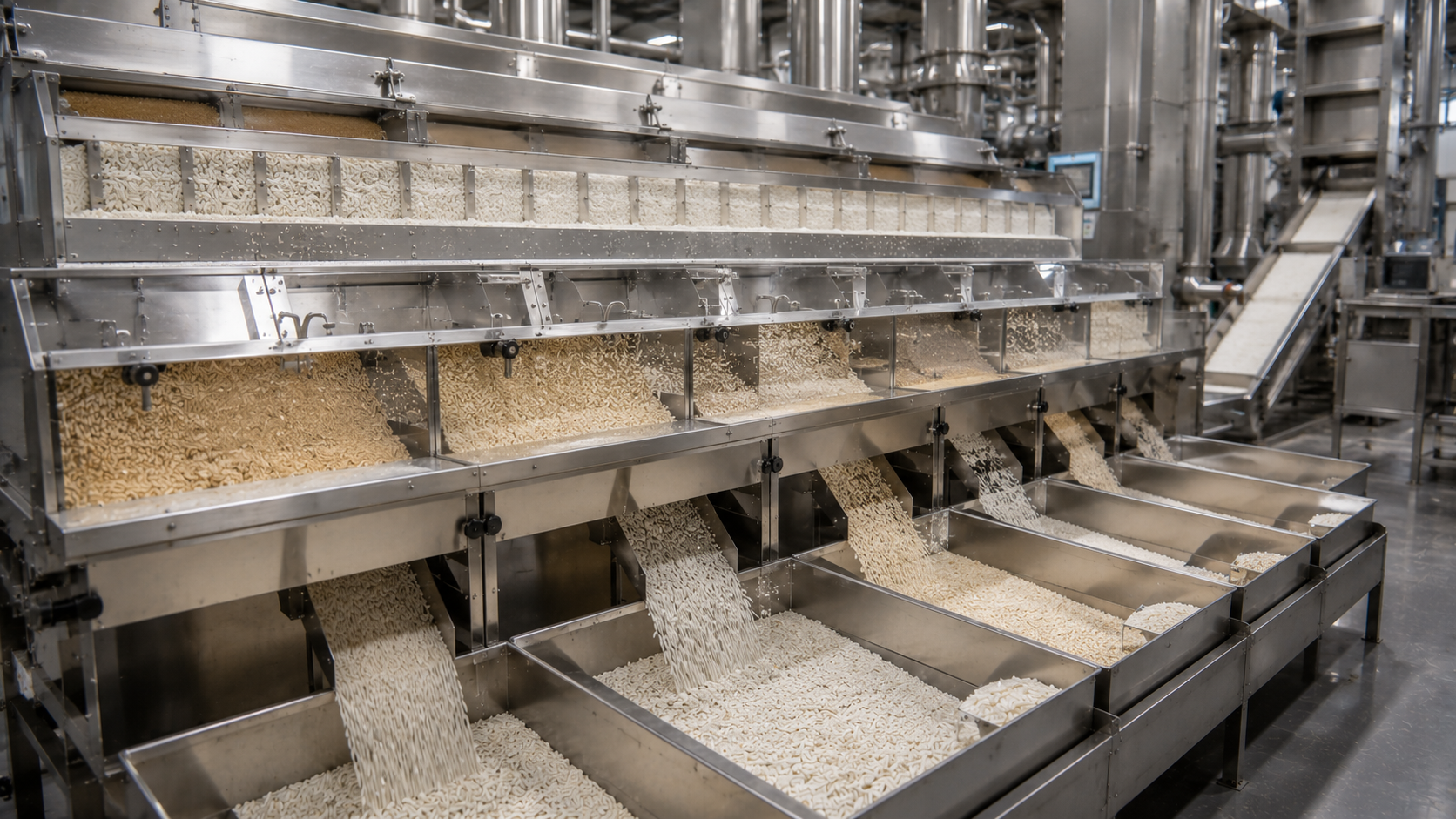
Length graders and other separation equipment can classify rice according to kernel dimensions, allowing whole grains and different categories of broken rice to be separated.
This matters because the proportion of broken kernels is an important commercial specification.
Different buyers and markets may require different grades, and a rice mill needs to produce those grades consistently rather than treating everything coming out of the milling line as one product.
Efficient milling is therefore partly about yield management—maximising the recovery of higher-value whole grains while properly utilising the other fractions produced.
Step 6: Sorting What Machines Earlier Could Not Remove
Even after cleaning and milling, individual grains may have defects.
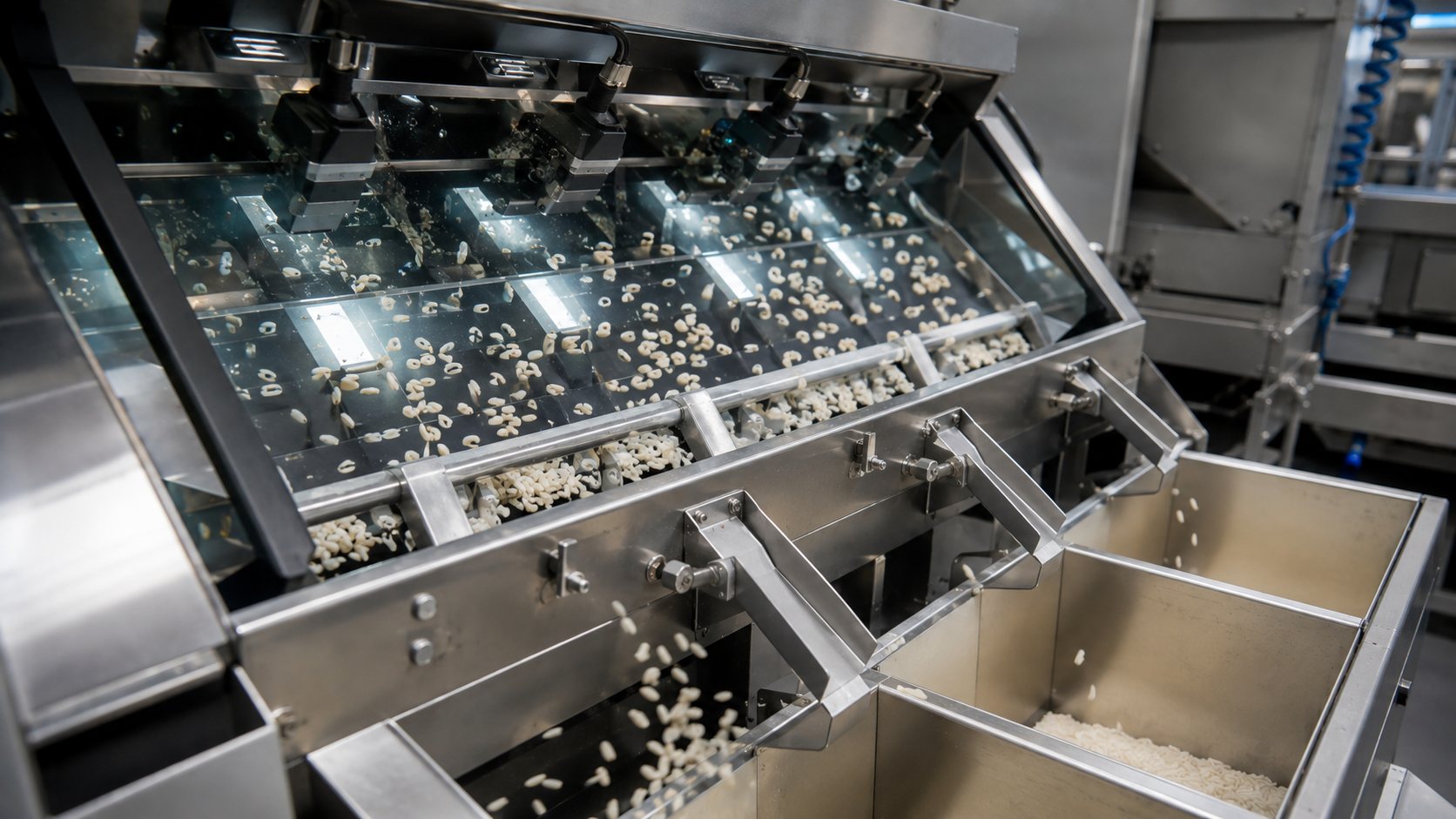
Modern processing lines can use optical or colour sorters to identify grains that differ from the desired product based on colour or other detectable characteristics.
The machine analyses grains moving rapidly through the system and rejects material outside the programmed parameters.
This adds another level of quality control.
Instead of judging an entire batch only by an average, sorting allows the processor to identify undesirable individual grains within a large volume of rice.
The result is a cleaner and more uniform finished product.
Step 7: Grading and Quality Control
Before packing, the rice has to meet the specification for the product being sold.
Depending on the grade and customer, quality parameters can include moisture, broken percentage, foreign matter, grain dimensions and appearance.
Sampling and testing are therefore essential.
This is especially important at an industrial scale.
A customer buying one bag expects it to resemble the next bag. A bulk buyer purchasing tonnes of rice expects one consignment to meet the same agreed specification as the previous one.
That consistency does not happen at the packaging machine.
It has to be maintained throughout the process.
Step 8: Packing and Storage
Only after the rice has been cleaned, milled, graded, sorted and checked does it reach the packing stage.
The required quantity is weighed and filled into suitable packaging depending on whether the product is intended for retail, institutional customers or bulk supply.
The finished bags then have to be stored appropriately before dispatch.
At this point, the transformation is complete:
Paddy → Cleaning → Drying → Husking → Paddy Separation → Whitening → Polishing → Grading → Sorting → Quality Control → Packing
What entered the facility as an agricultural crop leaves as a standardised food product.
What Happens to Everything That Is Removed?
One of the most interesting parts of rice processing is that the finished rice is only one output of the mill.
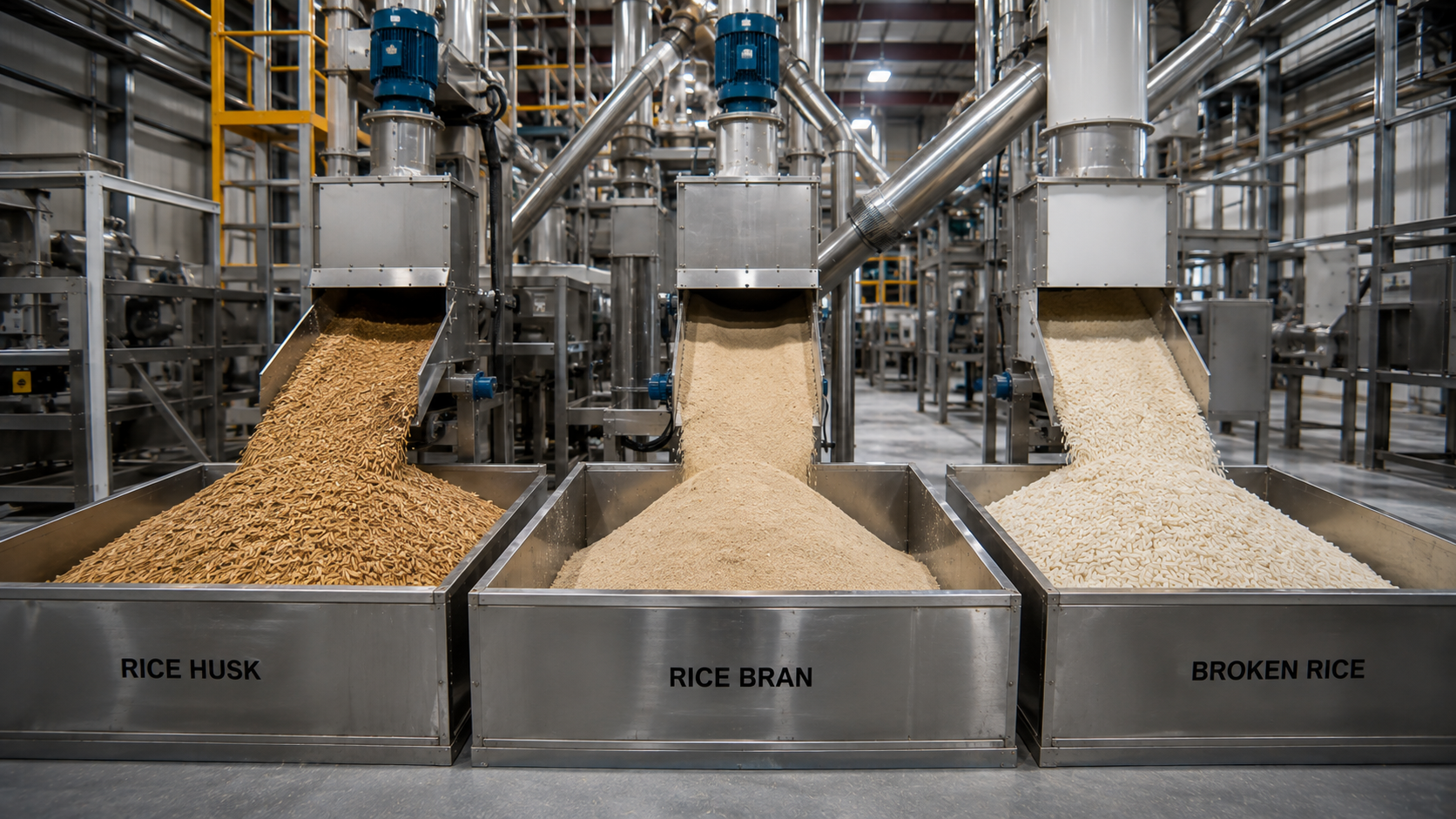
The process also generates rice husk, rice bran and broken rice.
These are not necessarily waste.
Rice bran has applications including the production of rice bran oil and animal feed. Broken rice has its own food and industrial markets. Rice husk can also be used for applications such as fuel and energy generation.
Efficient rice manufacturing therefore involves looking at the entire paddy grain and finding productive uses for its different fractions.
The Difference Between Milling Rice and Manufacturing It Consistently
The basic principles of rice milling have existed for generations.
What changes at an industrial scale is the degree of control.
A modern rice-processing operation has to manage incoming paddy quality, moisture, machine settings, grain breakage, grading, sorting, product specifications, packing and storage—continuously.
Because the objective is not to produce one good batch.
It is to produce the required quality batch after batch.
Within Maa Kudargarhi Group’s food-processing operations, this manufacturing perspective guides how we look at agricultural processing: the value is created not merely by running raw material through machinery, but by controlling each stage between the raw crop and the finished product.
So the next time a bag of rice is opened, the product may look simple.
The process behind those uniform grains is anything but.